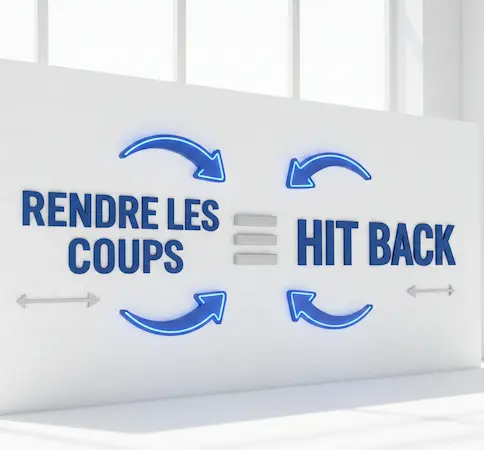
In the fascinating world of translation strategies, the chassé-croisé (literally "crossed chase") is one of the most elegant and revealing techniques, highlighting the structural differences between English and French. This method involves reversing the translation order between a verb and its complement, creating a grammatical mirror effect.
What is Chassé-Croisé?
Chassé-croisé is a specific translation technique used when translating from English to French. It applies when an English verb is followed by a complement (particle, preposition, or resultative element). Instead of translating in the order of appearance, we reverse: the complement becomes a verb, and the verb becomes a complement. It's like a linguistic dance where partners exchange their roles.
The Three Cases of Chassé-Croisé
1. Phrasal Verbs (Verbs with Adverbial Particles)
English phrasal verbs often form a new semantic unit. In some cases, they can be translated by a specific French verb, but chassé-croisé remains an elegant option. Examples:
- hit back ↔ rendre les coups (the particle "back" becomes the verb "rendre" - to give back)
- They chopped the tree down. ↔ Ils abattirent l'arbre à coups de hache. (the particle "down" expresses the result: the tree falls; "chopped" becomes the means: with ax blows)
2. Verbs with Prepositional Particles (Expressing Movement or Evolution)
This is where chassé-croisé reveals its full power. The English preposition, which often expresses direction or the result of an action, becomes the main verb in French. The English verb transforms into a complement of manner. Examples:
- He groped his way across the room. ↔ Il traversa la pièce à tâtons. ("across" becomes "traversa" - crossed; "groped" becomes "à tâtons" - groping)
- He strode into the house. ↔ Il entra à grands pas. ("into" becomes "entra" - entered; "strode" becomes "à grands pas" - with big steps)
- His mother nursed him back to health. ↔ Par ses soins, sa mère lui fit recouvrer la santé. ("back to health" becomes "recouvrer la santé" - recover health; "nursed" becomes "par ses soins" - through her care)
- to work oneself to death ↔ se tuer à la tâche ("to death" becomes "se tuer" - to kill oneself; "work" becomes "à la tâche" - at the task)
3. Resultative Structures
English resultative structures express the result of an action. In French, this result often becomes the main verb, while the initial action becomes the means or manner. Examples:
- She has worked herself tired. ↔ Elle s'est épuisée à la tâche. ("tired" becomes "épuisée" - exhausted; "worked" becomes "à la tâche" - at the task)
- He kicked the door shut. ↔ Il ferma la porte d'un coup de pied. ("shut" becomes "ferma" - closed; "kicked" becomes "d'un coup de pied" - with a kick)
- The boss wants it done by the end of this week. ↔ Le patron veut que ce soit fait avant la fin de la semaine. (here, the chassé-croisé is less obvious as the structure changes completely)
- She threatened him into signing. ↔ Elle l'a fait signer en usant de menaces. ("into signing" becomes "fait signer" - made sign; "threatened" becomes "en usant de menaces" - by using threats)
- I managed to talk him out of joining the army. ↔ J'ai réussi à le dissuader de s'engager dans l'armée. ("out of joining" becomes "dissuader de s'engager" - dissuade from joining; "talk" becomes implicit in "dissuader")
Important: Chassé-Croisé Is Not Systematic!
Not all resultative structures require chassé-croisé. Sometimes, direct translation works perfectly: I have painted my bookcase black. ↔ J'ai peint ma bibliothèque en noir. Here, "painted" remains "peint" and "black" becomes "en noir" (in black). No reversal, no chassé-croisé.
Why Does Chassé-Croisé Exist?
This technique reveals a fundamental difference between English and French in how they conceptualize action:
- English often emphasizes the manner of the action (the main verb) and adds the direction or result as a complement.
- French generally prefers to emphasize the result or direction (the main verb) and relegates the manner to the status of an adverbial complement.
Thus, "He ran into the room" naturally becomes "Il entra dans la pièce en courant" (He entered the room running) — French privileges the arrival (entering) rather than the manner (running).
The Art of Chassé-Croisé
Mastering chassé-croisé means understanding that languages don't carve up reality in the same way. What is primary in one language can become secondary in another. It's about accepting the need to completely reorganize the informational hierarchy of a sentence to make it sound right. Chassé-croisé reminds us that translation isn't just about changing words — it's sometimes about changing perspective on the action itself.